
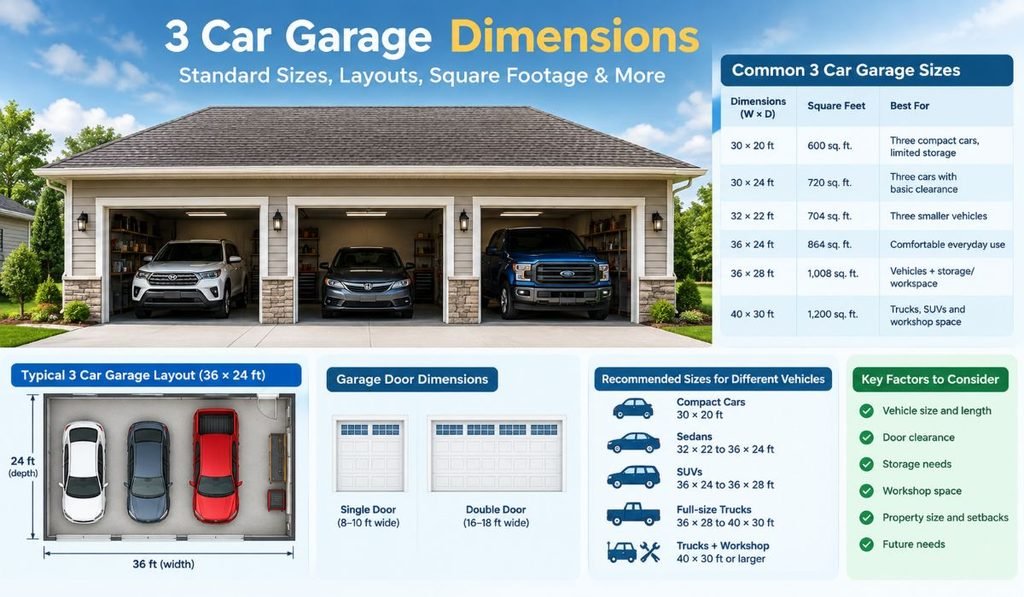
Choosing a suitable 3 car garage dimensions is important because a garage needs more than just room to accommodate three cars. You will also require adequate space to open the car doors, maneuver around the vehicles and you may need to store tools or equipment, and also possibly construct a workshop or storage area.
There are 30 × 20-foot garage layouts, which fit three cars compactly; or a big-boy type with dimensions like 40 × 30-feet, or even a custom-build. 36 × 24 feet is a typical size you may begin from with still enough space for a comfortable three-car garage (864 square feet of floor area).
What Are the Standard 3 Car Garage Dimensions?
Of course, there is not one universal size of a three-car garage as it ultimately depends on the sizes of the vehicles inside, garage layout and storage area needed, and space available on your property.
Typical measurements for a three-car garage are 30–40-feet wide and 20–30 feet deep. Compact vehicles can work with small layouts, while SUVs, pickup trucks, and garages that double as storage and workshop space are a better fit for a larger garage.
| Garage Size | Square Feet | Best For |
| 30 × 20 ft | 600 sq. ft. | Three compact cars, limited storage |
| 30 × 24 ft | 720 sq. ft. | Three cars with basic clearance |
| 32 × 22 ft | 704 sq. ft. | Three smaller vehicles |
| 36 × 24 ft | 864 sq. ft. | Comfortable everyday use |
| 36 × 28 ft | 1,008 sq. ft. | Vehicles plus storage/workspace |
| 40 × 30 ft | 1,200 sq. ft. | Trucks, SUVs and workshop space |
3 Car Garage Dimensions in Feet
Width – Probably one of the most critical measurements for a three-car garage, width is important in that it determines how many cars can actually fit in the garage. A very narrow garage might actually fit 3 cars, but only if you cannot open doors or walk around anything.
A simple three-car garage begins at approximately 30 feet of width, while 36 feet offers much more in usable space. Wider 40-foot designs leave more headroom for trucks, SUVs, storage cabinets and workbenches.
Depth is also important. A 20 foot depth will suffice for smaller cars while a 24- to 30-foot depth eases access and storage space for longer vehicles.
How Many Square Feet Is a 3 Car Garage?
For example:
36 ft × 24 ft = 864 square feet
| Dimensions | Square Footage |
| 30 × 20 ft | 600 sq. ft. |
| 30 × 24 ft | 720 sq. ft. |
| 32 × 22 ft | 704 sq. ft. |
| 36 × 24 ft | 864 sq. ft. |
| 36 × 28 ft | 1,008 sq. ft. |
| 40 × 30 ft | 1,200 sq. ft. |
What Is the Minimum Size for a 3 Car Garage?
One standard measure is compact: approximately 600 square feet or about the size of a unit 30 × 20. It works for three smaller vehicles in there, but leaves no space left over at all for getting around or storing things.
Depending on whether you park a large SUV or pickup truck in your garage every day, parking at minimum size may get uncomfortable. Practical parking area is compromised for vehicle width, mirror stalks, door-opening space, and walking clearance.
As a result, many homeowners for everyday usage take into account 36 × 24 feet footprint instead of the smallest rectangular shape possible.
Is 36 × 24 a Good Size for a 3 Car Garage?
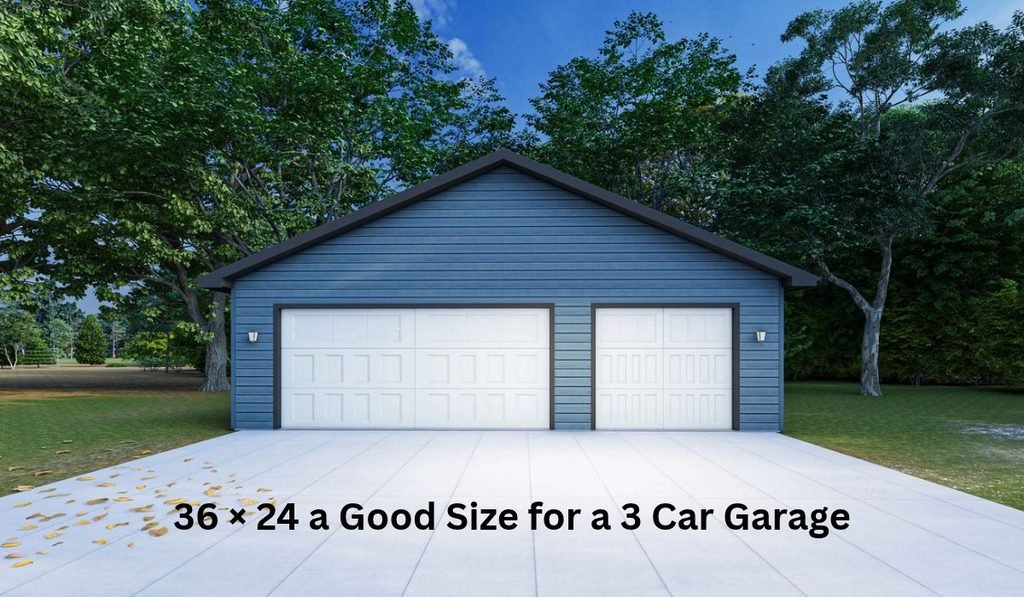
Sure, you often reference a three-car garage (and yes 36 × 24 feet) and this gives 864 square feet.
The garage can be designed to occupy a level area 36 feet across, with three bays each around 12 feet wide. That provides more latitude than a 30-foot-wide garage, and helps in getting in and out of vehicles.
The 24-foot depth also provides room for many passenger vehicles and SUVs, with some space available for storage depending on the vehicle sizes and interior layout.
But for giant pickup trucks or just a large shop, to go deeper or wider could certainly be roomier.
3 Car Garage Dimensions for SUVs and Trucks
Most compact cars just require a bit less space relative to SUVs and pickup trucks which have much greater volatility. Depth is especially important because full-size pickup trucks can get near 20 feet long. Today, garage sizing guides typically recommend more massive three-vehicle layouts of at least 36 × 24 feet or more, and 40 × 30 feet offers a lot of additional room for huge vehicles and workspace.
| Vehicle Type | Suggested Garage Size |
| Compact cars | Around 30 × 20 ft |
| Sedans | Around 32 × 22 to 36 × 24 ft |
| SUVs | Around 36 × 24 to 36 × 28 ft |
| Full-size trucks | Around 36 × 28 to 40 × 30 ft |
| Trucks + workshop | 40 × 30 ft or larger |
3 Car Garage Door Dimensions
The type of garage door will have an immediate impact on how the space is utilized
Common options include:
- Three individual single garage doors
- One double garage door plus one single door
- Two double doors in a custom arrangement
Garage doors are usually about 8–10 feet wide for singles, and double garage doors are generally approximately 16–18 feet wide.
All of this information can be used to create the specific size door and configuration you require. For example a 36 ft. wide garage could use three individual doors, an approximate 9 ft. wide opening for each, or a double door & single door combination.
You can access each parking bay with three individual doors, or one wide opening for two vehicles by adding a double door.
3 Car Garage Layout Ideas
1. Three Cars Side by Side
This is the simplest configuration. On several levels, the three vehicles all park next to each other – one in its designated bay.
Best for: Families with three cars in daily use.
2. Double Door + Single Door
It utilizes one bigger door for two cars with a dedicated single door for the third.
Best for: Homeowners looking for alternative looks or joint access to 2 vehicles.
3. Tandem 3 Car Garage
A tandem arrangement puts one parking spot behind the other, instead of placing all three vehicles side-by-side.
Best: Narrow properties where the lot has less front yard planting but more available depth.
Alternatively, tandems are also handy for a third vehicle which is used less often but this makes access to the rear parking position more awkward.
Recommended 3 Car Garage Ceiling Height
Space in the garage height should be considered in addition to its width and depth. A regular garage typically has an 8- to 9-foot ceiling, while a taller garage also provides extra leeway for storage, larger vehicles or future workshop equipment.
Discuss any clear height you will need to install a vehicle lift, overhead storage and tall shelving with the garage designer prior to construction.
How Much Storage Space Do You Need?
Of course, three cars swallow most of a smaller garage. If you want bicycles, lawn equipment, tools, shelves, sports equipment or a workbench also additional floor area helps.
Which is why a 36 × 28-foot or even a 40 × 30-foot plan might be better than a more economical and compact one at say, 30 × 20-feet, if storage is an important factor.
Consider allocating dedicated areas for:
- Wall-mounted shelving
- Tool storage
- Bicycles
- Lawn equipment
- Sports equipment
- Freezers or refrigerators
- Workbenches
- Seasonal items
It is easier to plan on storage before building rather than trying to develop more space after the garage must be finished.
Factors to Consider Before Choosing 3 Car Garage Dimensions
Here are some things to consider before planning thoroughly:
Vehicle Size
This includes measuring the real length and breadth of each car you want to park. Avoid relying solely on the quantity of parking lot slots.
Door Clearance
It should provide enough space to open vehicle doors without hitting another vehicle, a wall, or storage equipment.
Storage
If the garage is also used for storage, expand the footprint instead of using all available floor space to park vehicles.
Workshop Space
Additional space is needed for workbenches or hobby areas outside of the parking footprint.
Property Size
The size of your garage is limited by the available lot width, setbacks, driveway dimensions and local building requirements.
Future Needs
Think about future vehicle purchases. A three-car garage that easily fits sedans may be less usable if you go out to purchase large SUVs or trucks later on.
3 Car Garage Dimensions: Quick Summary
The size you’ll need varies and depends on how you are planning to use the garage. For example, a 30 × 20-foot garage can serve as a compact option, while that practical size – 36 × 24 feet – is often quoted for three cars. For example, options like 36 × 28 or even 40 × 30 feet also offer additional space for storing, SUVs and trucks in addition to engaging in storage and workshop activities.
| Requirement | Suggested Starting Size |
| Compact 3-car garage | 30 × 20 ft |
| Basic 3-car garage | 30 × 24 ft |
| Comfortable 3-car garage | 36 × 24 ft |
| Vehicles + storage | 36 × 28 ft |
| Trucks/SUVs + workshop | 40 × 30 ft |
FAQs
What is the standard 3 car garage size?
A commonly referenced size is 36 × 24 feet, providing approximately 864 square feet. However, actual garage dimensions vary based on vehicles, layout, storage, and property constraints.
Is a 30 × 20 garage big enough for three cars?
It can accommodate three compact vehicles, but the layout will be relatively tight. It provides 600 square feet and limited additional space for storage.
How big should a 3 car garage be for trucks?
For three larger trucks, a garage around 40 × 30 feet can provide more practical room for vehicle clearance, storage, and workspace. The exact requirement depends on the dimensions of the trucks.
How many square feet is a 36 × 24 garage?
A 36 × 24-foot garage has 864 square feet based on the overall rectangular footprint.
Also Read: How Tall Is a Monster Can || How Long Is 9 Inches || How Long Is 6 Inches
2 Comments
Comments are closed.